Figure 1. Coral Reef From Coral Reef by Jürgen Freund, http://d2ouvy59p0dg6k.cloudfront.net/img/web_289583_4_528276.jpg
Follow-up Research
This is a follow-up experiment to the research, “Neural Network Radiative Transfer for Imaging Spectroscopy”. This time lead by professor Deshpande, many of the previous members joins the research to continue their work on the algorithm that may potentially replace the expensive Radiative Transfer Model (RTM) method.
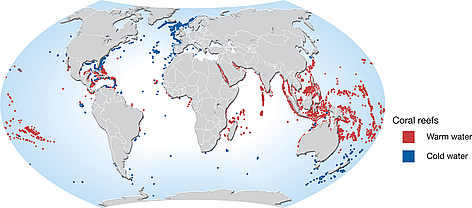
Figure 2. Coral Reef Spread. From WWF by Hugo Ahlenius, UNEP/GRID-Arendal,http://d2ouvy59p0dg6k.cloudfront.net/img/coraldistribution_001_362390.png
Context
The cause of the rapid and on-going demise of coral reef has long been suspected to be caused by the climate change but drawing a direct link between the greenhouse gases and the phenomena has been difficult (Deshpande, et al, 2019). The paper illustrates that the root cause is has been the inability to process necessary and large scale of data into information. By refining the process via the reduction of the computational cost, it has become easier and more scalable to perform. In this research paper, professor Deshpande and his colleagues tackled the challenge of producing a concrete evidence to support the long-predicted hypothesis that links the demise of coral reefs and climate change. The conclusion of the research suggests two very important achievements. Not only does the research successfully supports the hypothesis with stronger evidence, it also suggests the powerful impact the technology would have on the future of the studies, opening new avenue of research and providing powerful tools for scientists.
References
Bue, B. D., Thompson, D. R., Deshpande, S., Eastwood, M., Green, R. O., Mullen, T., . . . Parente, M. (2019). Neural Network Radiative Transfer for Imaging Spectroscopy. Atmospheric Measurement Techniques Discussions, 1-16. doi:10.5194/amt-2018-436
Deshpande, S., Bue, B. D., Thompson, D. R., Natraj, V., & Parente, M. (2019). Learning Radiative Transfer Models for Climate Change Applications in Imaging Spectroscopy. arXiv preprint arXiv:1906.03479.
Upgrade or Replace There are two approaches when upgrading an existing system: improve the current system or replace the system. The former enjoys the extensive amount of previous work, but it also faces possible short-comings inherit to a design based on outdated technologies. The latter option provides an opportunity to design a solution based on the latest technologies, it but may prove costly to replace old system. Most of the researchers deemed replacement too expensive and opted to supplement the existing system by solving the existing problems. Professor Tapio Schneider and his colleagues decided otherwise (Perkins, 2018). They created a team called CliMA (Perkins, 2018). Picture 1. Professor Tapio Schneider. From New Climate Model to Be Built from the Ground Up by S. Diani, 2019, https://www.sciencemag.org/sites/default/files/styles/inline__699w__no_aspect/public/350cs_80727X_Tapio_0.jpg?itok=6HRPTU8g New Climate Model This young but ambitious project aims to replace ...
AI for Earth In the Microsoft blog called “Researchers turn to AI in a bid to improve weather forecasts” by Roach, the author highlights some of the company's contribution to the research that benefits mankind. Through the AI for Earth initiative, the company funds various challenging research projects that studies Earth. The blog also highlights the social activities, such as hackathons, that illustrates some of the current trends of using machine learning to solve difficult problems. References Roach, J. (2019, May 20). Researchers turn to AI in a bid to improve weather forecasts. Retrieved May 26, 2019, from https://blogs.microsoft.com/ai/ai-subseasonal-weather-forecast/
Origin The “AI and climate: On the bleeding edge with a pioneering researcher” by journalist Crowder is a dialogue between the journalist and professor Monteleoni. The professor is credited to coining the term, ‘climate informatics’ in 2012 (Crowder, 2018). Crowder interviewed the professor after 6 years to find out more about the new-born field of research and just how much the field has grown since. Picture 1. Professor Monteleoni. From Predictability assessment of northeast monsoon rainfall in India using sea surface temperature anomaly through statistical and machine learning techniques by L. Crowder, 2018. https://thebulletin.org/wp-content/uploads/2018/02/cmontel-680x1024.jpg In the conversation, the professor described climate informatics as “innovation at the intersection of data science and climate science” (Crowder 2018). This is similar to bioinformatics that became popularized more than a decade ago which combined biological data with data science, and professor...



Comments
Post a Comment